How to Clear, Reset, and Turn Off a Check Engine Light

 USD
English
A conventional 12-volt car battery usually lasts three to five years. That is a planning range, not a fixed expiry date. Heat, repeated short trips, long storage, vibration, charging problems, and deep discharge can push a battery toward the short end. A battery in a cooler climate with regular longer drives may last beyond five years.
Start annual testing when the battery reaches three years old. Test sooner if the engine cranks slowly, the lights dim during starting, the battery has gone flat more than once, or the case shows swelling, cracking, or leakage. A portable jump starter can get a vehicle moving after an unexpected no-start, but it cannot reverse battery aging or repair a charging-system fault.
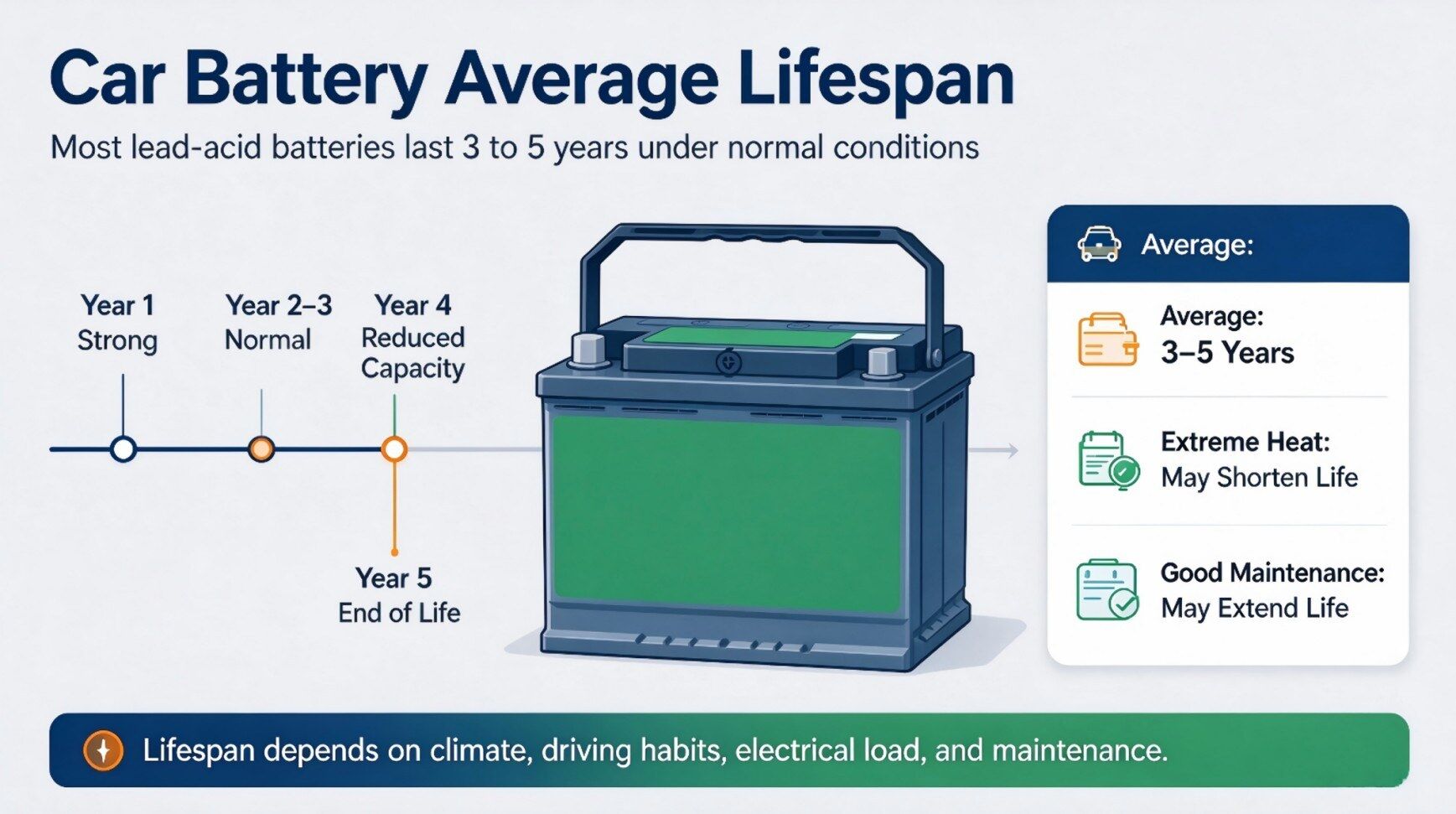
How long does a car battery last in everyday driving?
For most drivers, three to five years is the useful answer. AAA describes that as the normal wear period for a car battery and identifies time, heat, and vibration as three major influences. It also reports that a battery may last five years or longer in a cooler northern climate but approximately three years in a hot southern location.
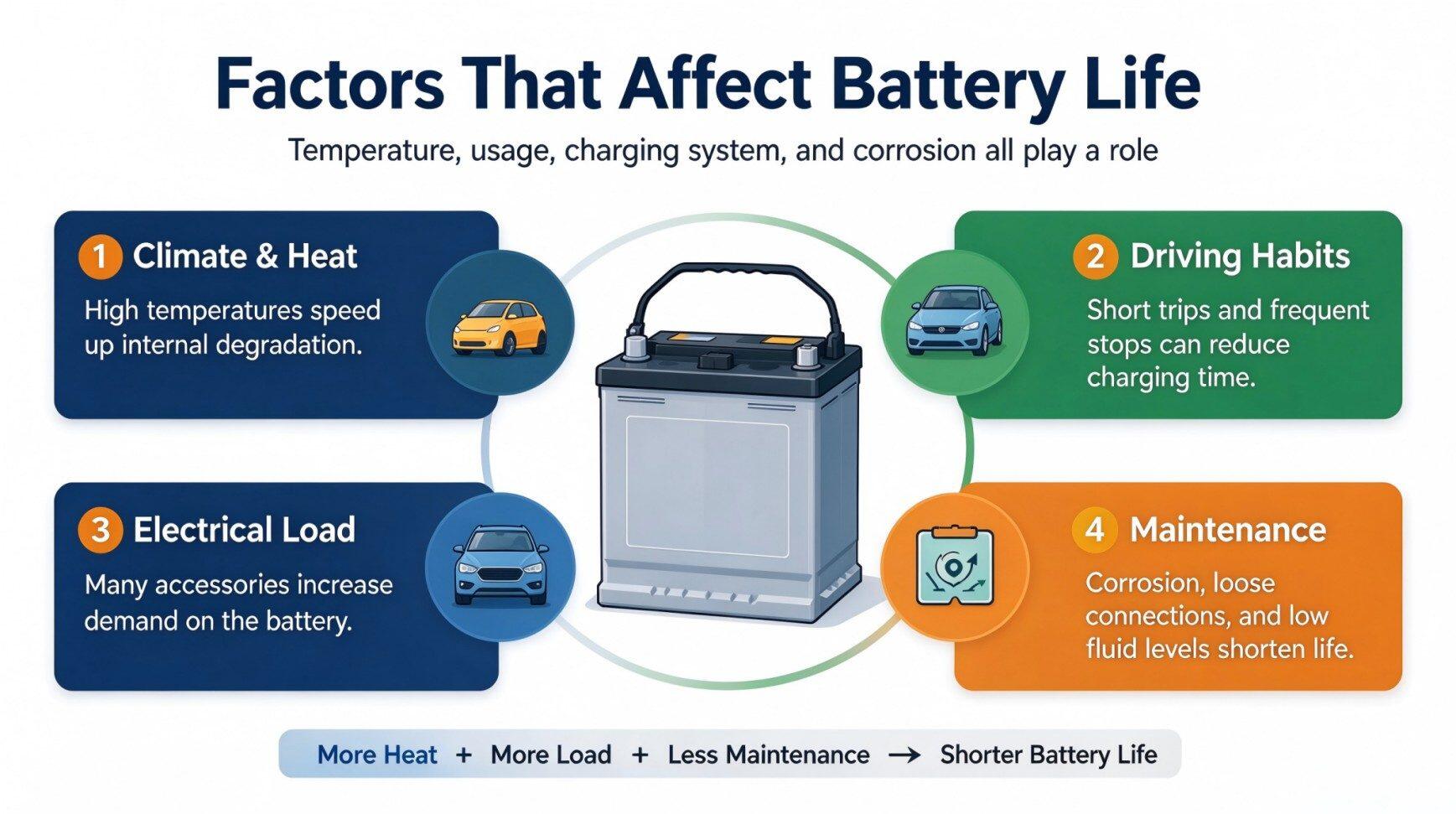
The calendar cannot show how much cranking ability remains. Two batteries installed on the same day may age differently because one sits over a hot engine, makes two short trips a day, and spends weekends running accessories while parked. The other may live in a mild climate and receive enough driving time to recover the energy used at each start.
Treat the third anniversary as a testing point. A strong result, normal starting, clean connections, and an undamaged case may support continued use. A weak result or repeated no-start deserves diagnosis before the next temperature extreme.
How long should a car battery last by battery type?
The correct replacement must match the chemistry and performance class specified by the vehicle maker. Do not replace an AGM or EFB unit with a basic flooded battery just because it fits the tray.
|
12-volt starter-battery type
|
One-sentence definition
|
Broad planning range
|
What changes the range
|
|
Flooded lead-acid |
A flooded battery has liquid electrolyte moving around conventional lead plates. |
About 3-5 years |
Heat, water loss in serviceable designs, vibration, and repeated partial charge can shorten life. |
|
AGM |
An Absorbent Glass Mat battery holds electrolyte in fiberglass mats and tolerates higher cycling demand than a basic flooded design. |
About 4-7 years |
Start-stop duty, under-hood heat, incorrect charging, and long periods at low charge still cause wear. |
|
EFB |
An Enhanced Flooded Battery is a strengthened wet-cell design built for more frequent cycling, often in basic start-stop vehicles. |
About 4-6 years |
Start-stop frequency, temperature, charging strategy, and accessory loads matter. |
|
Automotive lithium starter battery |
A lithium starter battery uses lithium cells and an electronic battery-management system instead of lead-acid chemistry. |
Often 8-20 years in manufacturer planning claims |
Vehicle approval, cell chemistry, thermal control, electronics, and real-world duty create a wide range; it is not a drop-in choice for every car. |
These ranges are budgeting guides, not warranties. Interstate Batteries gives three to five years as the normal range for most car batteries and advises using the type required by the owner's manual. It also warns that some vehicles designed for AGM can be damaged or poorly served by a traditional lead-acid substitution. The vehicle manual and application catalog take priority over a generic lifespan table.
How long can a car battery last in hot or cold weather?
Heat usually determines how fast the battery ages; cold often reveals the damage. High under-hood temperatures accelerate internal corrosion and fluid loss. Cold slows the battery's chemical reaction at the same time that thick engine oil and cold components increase starting demand.
|
Climate or operating condition |
Expected effect on life |
Practical response |
|
Hot southern or desert climate |
AAA reports approximately 3 years as typical in hot southern locations. |
Begin annual testing by year 3 and test before summer travel. Park under cover when practical. |
|
Mild or cool northern climate |
Five years or longer may be possible, according to AAA. |
Still test annually from year 3, especially before winter. |
|
Frequent trips under about 15 minutes |
The alternator may not restore all energy used for starting and accessories. |
Combine trips when practical and investigate repeated low state of charge. |
|
Vehicle parked for weeks |
Natural self-discharge and small standby loads reduce state of charge. |
Follow the vehicle and battery maker's storage instructions; check before returning to service. |
|
Rough roads or loose hold-down |
Vibration can damage plates and internal connections. |
Keep the correct hold-down secure and inspect the case. |
|
Repeated deep discharge |
Low charge encourages deterioration and can permanently reduce usable capacity. |
Find the cause instead of relying on repeated jump-starts. |
AAA's maintenance guidance says heat accelerates battery wear, particularly in warmer regions, while cold reduces starting power. Cold-weather failure is still common because a marginal battery has less available output just when the engine demands more.
A charged backup pack is useful during that late-life period. The Eigotrav PD-J220 6000A peak jump starter is listed for 12-volt vehicles up to 10L gas or 8.5L diesel. Check the product page and both manuals before use. The 6000A figure is peak output, not CCA, and it does not guarantee a start in every temperature or battery condition.
How long do car batteries usually last when trips are short?
There is no separate fixed lifespan for a short-trip car. Starting draws a burst of energy, and a brief drive may not replace it. Headlights, heated seats, blowers, defrosters, and infotainment can make the deficit larger. Over time, the battery spends more hours below full charge and may sulfate or lose usable capacity sooner.
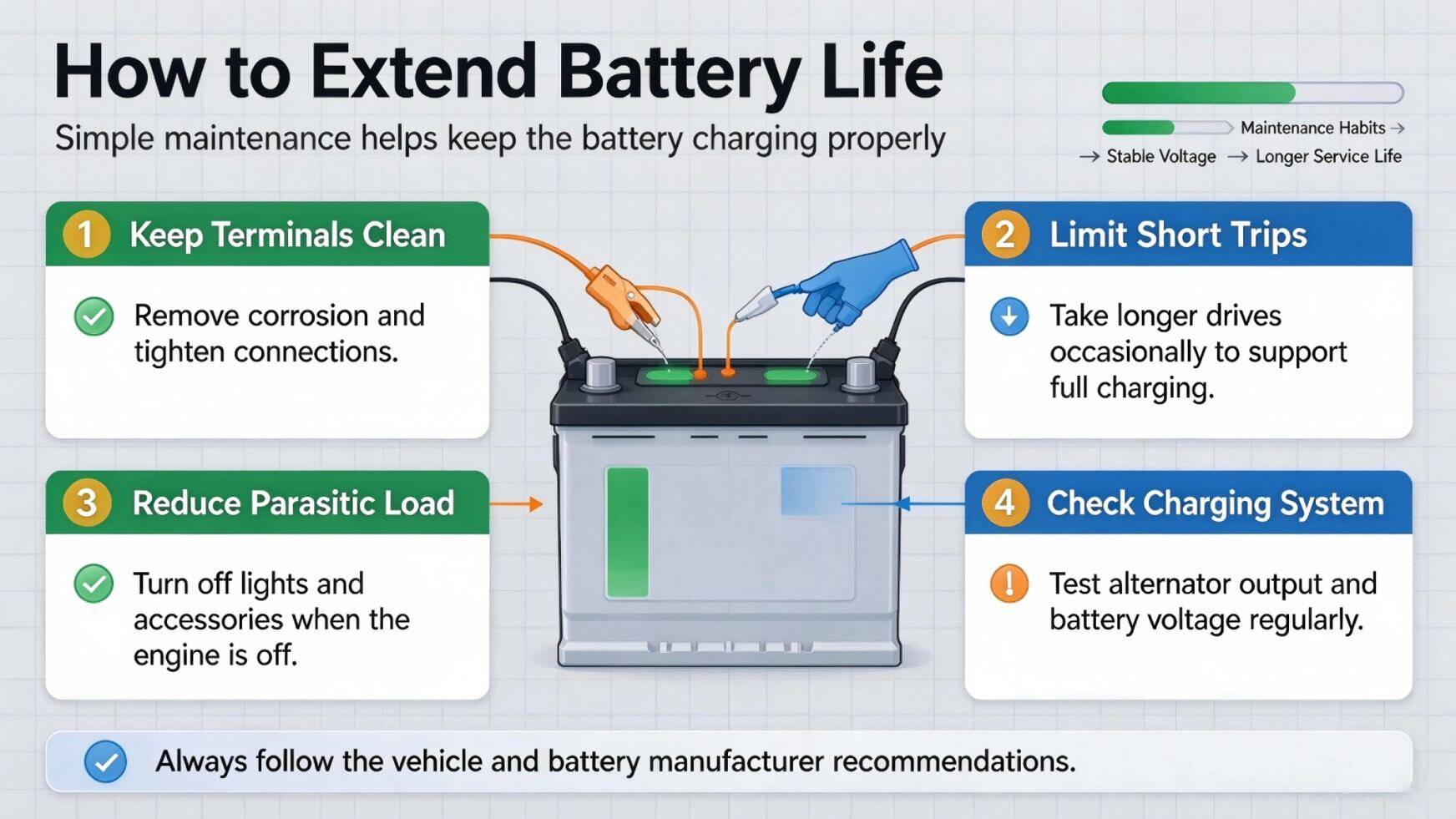
A simple weekly routine helps:
- Notice whether cranking speed has changed.
- Check that terminals and the hold-down are clean, tight, and undamaged during routine service.
- Arrange a battery and charging-system test if low charge returns.
- Record the installation month and start annual testing at year three.
- Follow the owner's manual for long-term storage and battery support. Modern vehicles may require model-specific procedures.
Do not assume that a longer drive will restore an old or damaged battery. If it repeatedly needs a jump, test the battery, alternator, starter circuit, cable connections, and parasitic draw.
How long does a battery last in a car that sits unused?
The answer depends on the battery's age and charge, ambient temperature, and the vehicle's standby draw. Security systems, keyless-entry receivers, clocks, and control modules continue to use a small amount of electricity after shutdown. A healthy, fully charged battery may tolerate a period of storage, while an older or partly charged battery can reach a no-start state much sooner.
Do not use a universal "days parked" number. Vehicle standby loads vary, and a hidden fault can drain a battery far faster than normal. If a car will sit for weeks, follow its manual. Some vehicles permit an approved battery-maintenance connection; others specify shutdown or storage steps. After storage, inspect the case and terminals before trying to start.
How long should car battery last before testing begins?
Begin annual testing at three years even if the car starts normally. AAA recommends this schedule because batteries can deteriorate without obvious warning. A test under load or a conductance test gives more useful health information than resting voltage alone.
Resting voltage mainly shows state of charge. A battery can read near 12.6 volts and still fail to deliver enough current under starter load. Test results also need context: temperature, charge level, rated CCA, and the vehicle's minimum requirement all affect the decision.
Two ratings appear often in battery discussions:
- CCA, or cold cranking amps, is the current a 12-volt lead-acid battery can deliver for 30 seconds at 0°F (-18°C) while meeting the rating standard's voltage threshold.
- RC, or reserve capacity, is the number of minutes a fully charged battery can deliver a specified current before voltage falls to the standard's cutoff.
CCA describes cold-start ability. RC describes endurance if the charging system stops supplying power. Neither number tells you the exact remaining calendar life.
How long car battery last depends on depth of discharge
The phrase "how long car battery last" is ungrammatical, but it points to a useful issue: depth of discharge. Depth of discharge, or DoD, is the share of a battery's nominal capacity removed before it is recharged. A 30% depth of discharge means 30% has been used and about 70% remains.
Starter batteries are designed for brief, shallow discharges followed by prompt charging. They are not built for repeatedly powering camping loads or accessories until deeply discharged. Deeper and more frequent discharge generally consumes cycle life faster.
A cycle-life estimate can be expressed as:
Estimated years = rated equivalent full cycles / equivalent full cycles used per year
For an illustration only, a battery rated for 1,000 equivalent full cycles and used at 200 equivalent full cycles per year would reach 1,000 / 200 = 5 years. Do not apply that result to a normal car battery unless its manufacturer supplies the relevant cycle-life curve. Starter-battery wear also comes from heat, corrosion, time, vibration, and partial-state-of-charge operation, so a single equation cannot predict its replacement date.
How long does a battery last after the first slow start?
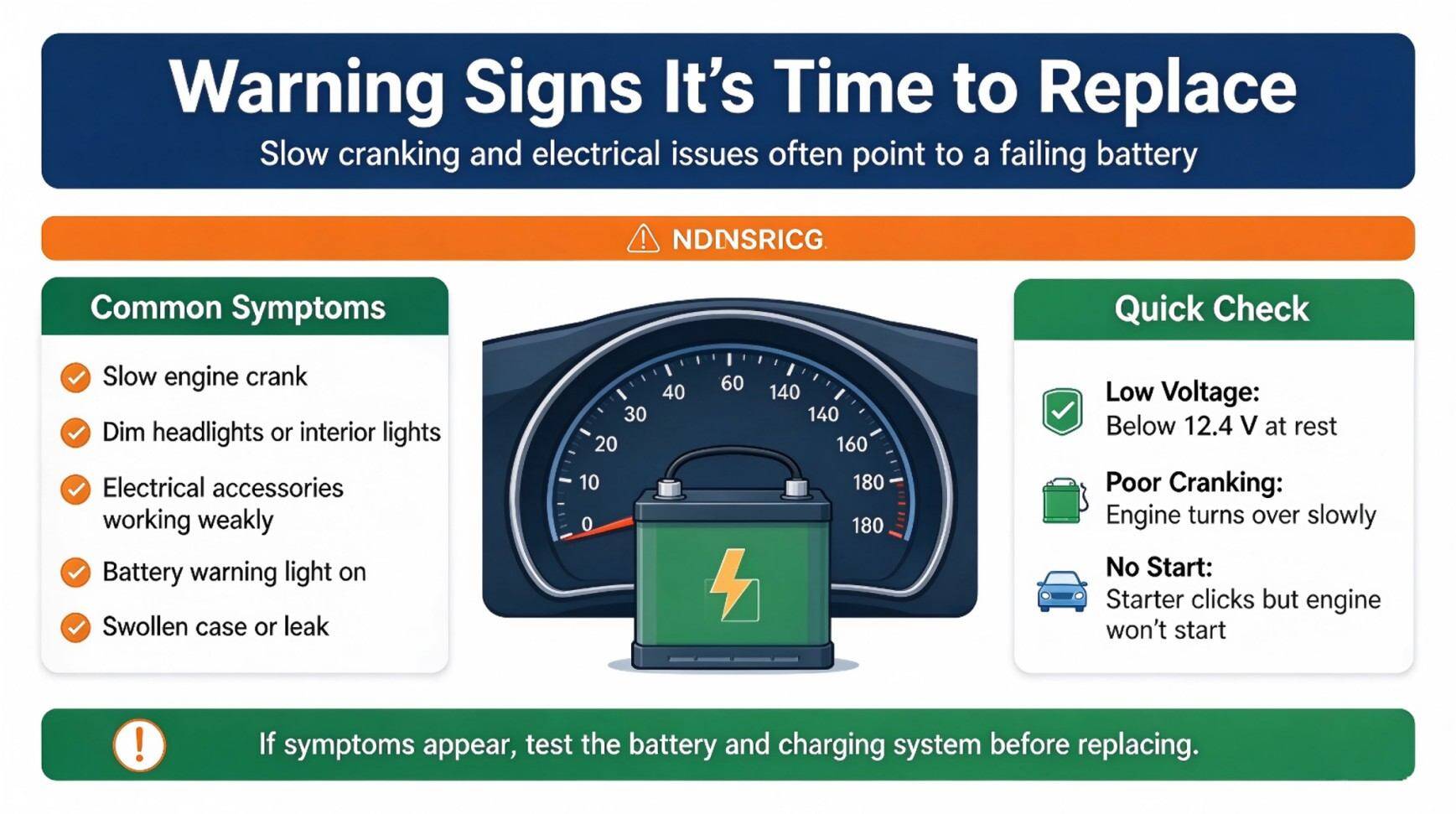
No honest source can turn one slow crank into a countdown. The cause could be low state of charge, cold oil, corroded terminals, a worn starter, a charging fault, or permanent battery deterioration. Treat the symptom as a prompt to inspect and test, not as proof that the battery has days left.
|
Warning sign |
Possible explanation |
What to do |
|
Cranking is slower than normal |
Weak battery, cold conditions, cable resistance, or starter trouble |
Limit repeated attempts and arrange a full starting/charging test. |
|
Lights dim sharply during starting |
Excessive voltage drop under load |
Check connections and battery performance. |
|
More than one jump is needed |
Lost battery capacity, parasitic drain, alternator fault, or loose connection |
Diagnose the full system before replacing parts. |
|
Battery light remains on while driving |
Usually a charging-system warning, not a battery-age meter |
Reduce unnecessary loads and seek service promptly. |
|
White or blue-green terminal corrosion |
Connection resistance or acid vapor exposure |
Have the terminals cleaned safely and inspect for leakage. |
|
Swollen, cracked, leaking, hot, hissing, or strong odor |
Possible internal failure, overcharge, freezing, or venting |
Do not jump or handle it; move away and arrange professional service. |
|
Electronics reset during starting |
Severe voltage drop or poor connection |
Test the battery and cable path. |
A jump starter is temporary roadside backup. It does not recharge the battery fully, restore lost plate material, or correct an alternator problem.
How long does a car battery usually last with start-stop?
Start-stop vehicles make many more engine starts, so they commonly use EFB or AGM batteries designed for greater cycling demand. The charging system may be calibrated for that chemistry, and some vehicles require battery registration or coding after replacement.
Use the exact type and minimum rating specified by the manufacturer. Interstate notes that EFB remains a wet-cell battery with free-flowing electrolyte, while AGM absorbs the electrolyte in fiberglass mats. It also warns that an EFB should not replace an AGM in a vehicle designed around AGM. Physical fit alone is not enough.
How long should battery last if the car has many electronics?
Added electrical demand does not create one predictable number. The real question is whether the charging system restores what the vehicle uses. Dash cameras with parking mode, aftermarket alarms, audio equipment, tracking devices, and control modules can add standby load. Factory energy management may also reduce charging under some conditions to improve fuel economy.
If the battery repeatedly reaches low charge, ask for a parasitic-draw and charging-system diagnosis. Replacing the battery without correcting the load may only restart the same cycle.
How long does the battery typically last before cold-weather trouble?
A three-to-five-year-old battery can appear normal in mild weather and struggle on the first cold morning. Cold reduces available output, while the starter needs more effort to turn the engine. Test before winter once the battery reaches three years, and act sooner if the crank sounds slower.
For a driver who also wants an emergency tire inflator, the Eigotrav PD-JA2 6000A peak jump starter is listed for 12-volt vehicles up to 10L gas or 8.5L diesel and includes a 150PSI compressor. Keep the pack charged and within its stated storage and operating limits. It is backup equipment, not evidence that an aging vehicle battery can be ignored.
How long does the average car battery last after a jump-start?
A successful jump says only that outside power helped the engine start. It does not measure the battery's remaining life. A healthy battery discharged by a light left on may recover after proper charging and testing. An old battery that cannot hold charge may fail again at the next stop.
After a jump:
- Follow the vehicle and jump-starter instructions for safe disconnection.
- Do not assume a short drive fully recharged the battery.
- Arrange testing if the cause was unknown, the battery is three years old or older, or another jump is needed.
- Replace the battery if it fails after proper charging, has a bad cell, or shows physical damage.
Eigotrav's guide to how portable jump starters work covers the operating principle and common reasons a pack may not deliver output.
How long a battery car last: separate 12-volt and EV traction batteries
The search phrase "how long a battery car last" can refer either to the small 12-volt battery in any vehicle or to the high-voltage traction battery in an electric car. This guide covers 12-volt starter and auxiliary batteries. An EV traction battery has different chemistry, cooling, controls, warranties, diagnostic methods, and replacement costs.
Even an electric vehicle usually has a separate low-voltage battery for locks, computers, contactors, and safety systems. Use the EV owner's manual and qualified service information rather than applying a three-to-five-year starter-battery rule to the high-voltage pack.
How long does a typical car battery last if it passes a test?
A passing test means the battery met the device's criteria at that time. It does not reset the age or guarantee another year. Continued use may be reasonable when the result is strong, starting is normal, the case is sound, and the consequence of an unexpected failure is manageable.
Retest before severe weather, a remote trip, or a period of storage. Preventive replacement may make sense when a battery is beyond its expected range and a no-start would create a serious access or safety problem, even if the latest result is marginally acceptable.
How long should a battery last in a car with good maintenance?
Good maintenance improves the odds; it cannot stop chemical aging. Keep the battery secure, have corrosion handled safely, address charging warnings, avoid leaving accessories on, and investigate repeated discharge. For serviceable flooded batteries, follow the maker's inspection procedure. Do not open a sealed battery.
Record the installation date and current test result. Those two facts are more useful than trying to remember whether the battery "seems old."
How long should car batteries last before replacement planning?
Begin planning at year three. Planning means checking the date, testing the battery, reviewing the vehicle specification, and deciding how much failure risk is acceptable. It does not mean every three-year-old battery belongs in recycling.
If cold-weather starting is a concern, compare the vehicle's voltage, fuel type, engine displacement, and product compatibility before choosing backup equipment. Eigotrav's jump starter collection lets drivers compare current 12-volt options. For a higher listed peak output with an integrated inflator, the PD-F130 page lists 9000A peak; its product body states compatibility with all gas engines and up to 12.0L diesel. Confirm current specifications on the page because the page title and body use different diesel figures.
How long to car batteries last? Read it as a lifespan question
"How long to car batteries last" is a common mistyped query. The direct answer remains three to five years for a conventional 12-volt car battery, with heat, use pattern, battery design, and testing determining where the individual battery lands. If the battery is already three years old, replace guessing with an annual test.
How long will a car battery last from today?
Age provides a risk band, not a date. Check the installation code or receipt, note the climate and driving pattern, and combine those facts with a current test. A two-year-old damaged battery needs action now. A five-year-old battery that still tests strongly may continue working, but it deserves closer monitoring and a replacement plan.
Frequently Asked Questions
How long does a car battery last on average?
Most conventional 12-volt car batteries last about three to five years. Hot climates often pull the result toward three years, while cooler conditions may allow five years or longer.
How long should a car battery last in a hot climate?
AAA reports approximately three years as typical in hot southern locations. Begin annual testing by year three and test before heavy summer travel.
How long can a car battery last in a cold climate?
Five years or longer may be possible in cooler northern climates, but cold raises cranking demand. Test annually from year three and before winter.
How long does a battery last in a car that is only driven weekly?
There is no universal number. Weekly use may be enough if the trips restore the starting energy, but short drives and standby loads can leave the battery undercharged. Diagnose recurring low charge rather than relying on a calendar.
How long should a battery last after it needs a jump?
One jump does not reveal remaining life. Correct the reason for discharge, recharge using the approved procedure, and test. Repeated jumps, failed testing, or physical damage are reasons for repair or replacement.
How long should car batteries last in start-stop vehicles?
Service life varies with start frequency, climate, and charging strategy. Use the specified EFB or AGM type, start annual testing at three years, and follow any battery-registration procedure required by the vehicle.
Plan before the next no-start
Check the battery's installation date today. If it is three years old, arrange a test before the next heat wave, freeze, or long trip. Replace it when testing, condition, and risk justify the decision, then return the old lead-acid battery through an approved collection route.
For temporary roadside backup, compare Eigotrav portable jump starters by vehicle voltage, gas or diesel engine size, listed peak output, and whether you need an integrated air compressor. Keep the selected pack charged, store it within its specified temperature range, and follow both manuals every time.
Recommend reading
Subscribe To Our Newsletter
You Can Get The News Of Our Products
SIGN UP
To be the most trusted mobile energy companion worldwide — making every drive, every trip, and every adventure worry‑free.
📮support@eigotrav.net
Payment Methods