What Size Jump Starter Do I Need? A Complete Guide for Choosing the Right Car Battery Booster

 USD
English
A conventional 12-volt car battery usually lasts about three to five years, but age is only the starting point. Heat, repeated short trips, long periods of storage, vibration, deep discharge, and a charging fault can shorten that window. Start annual testing when the battery reaches three years old. Replace it sooner if a proper test reports poor health, the case is damaged, or the car repeatedly needs a jump after other electrical faults have been ruled out.
That is the practical answer. A calendar alone cannot tell whether the next no-start will happen tomorrow or a year from now. Use the battery's age, climate, symptoms, and test results together.
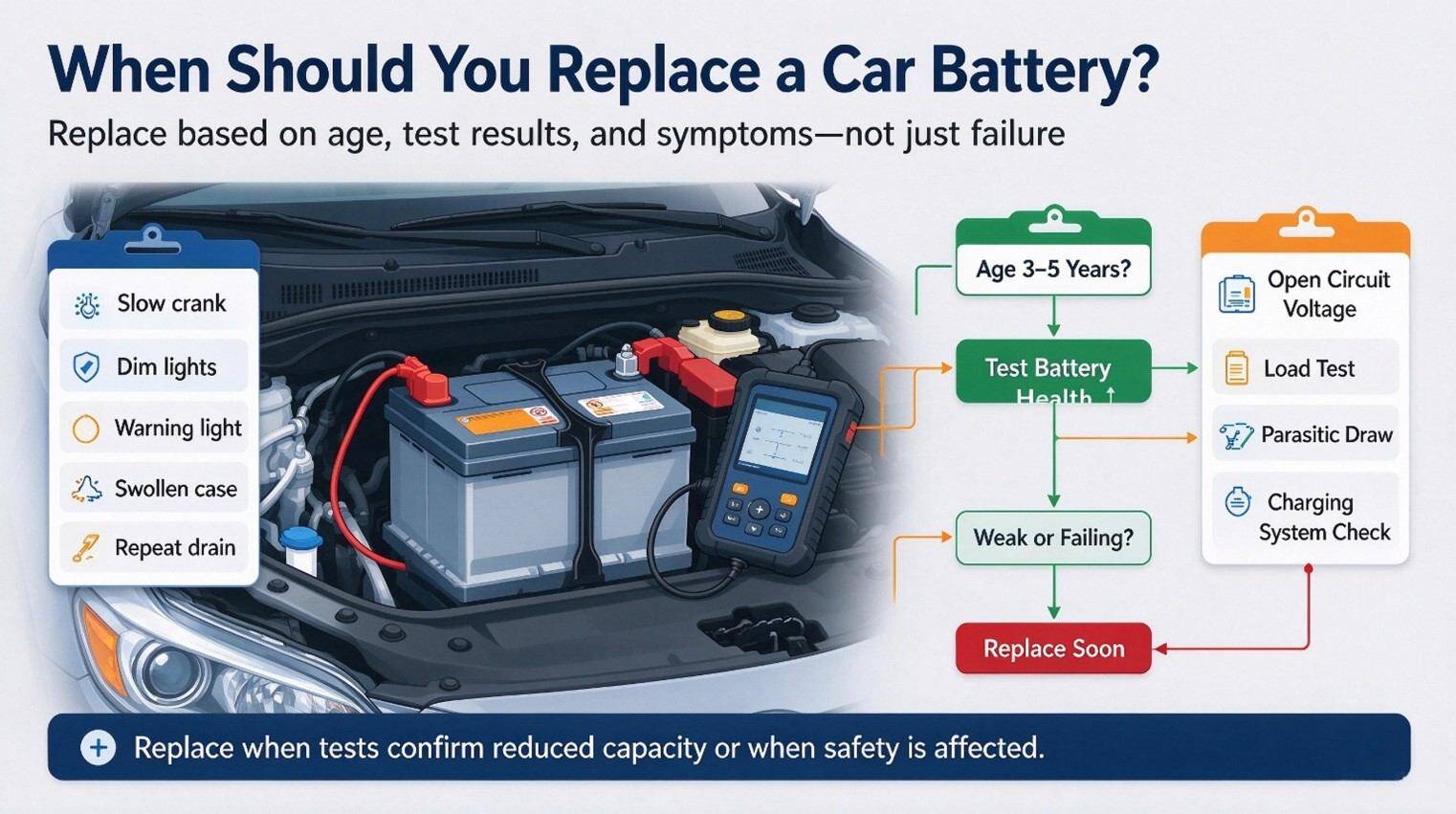
When to replace car battery: the short answer
Replace the battery when one of these conditions applies:
- A battery or conductance test reports "replace," "bad cell," or inadequate cranking ability after the battery has been fully charged.
- The case is swollen, cracked, leaking, or hot, or there is a strong rotten-egg smell. Stop handling it and arrange professional service.
- Starting remains slow after the terminals, starter, alternator, and parasitic drain have been checked.
- The battery repeatedly goes flat even though the charging system works and the car is used normally.
- The battery is near or beyond the usual three-to-five-year range and a failure would create an unacceptable risk, such as before a winter trip or a drive through a remote area.
AAA says the usual wear period is three to five years and recommends annual testing from year three. It also notes that a battery may last five years or longer in a cooler northern climate but about three years in a hot southern location. Those figures are planning ranges, not expiry dates.
Before the battery reaches that uncertain late-life period, keeping a charged portable jump starter in the car can reduce the chance that one weak start becomes a roadside wait. It is backup equipment, not a cure for an aging battery. A jump can get the engine running; it cannot restore lost battery capacity or correct an alternator fault.
How often to change car battery by type
The replacement battery must match the vehicle's specified chemistry, physical size, terminal layout, hold-down arrangement, and minimum CCA or amp-hour rating. Do not downgrade an AGM or EFB battery simply because a conventional flooded battery fits the tray.
|
Battery type |
One-sentence definition |
Practical planning range |
Best replacement rule |
|
Flooded lead-acid |
A conventional starter battery with liquid electrolyte around lead plates. |
About 3-5 years |
Test annually from year 3; replace on failed health testing, damage, or persistent starting symptoms. |
|
AGM |
An Absorbent Glass Mat battery holds its electrolyte in glass-fiber mats and is designed for higher cycling demand. |
Use the general 3-5-year testing window for planning; actual service may be longer or shorter |
Replace like for like when the vehicle specifies AGM; follow the vehicle's battery registration procedure if required. |
|
EFB |
An Enhanced Flooded Battery is a strengthened flooded design made for more frequent cycling, often in basic start-stop vehicles. |
Use the general 3-5-year testing window for planning; start-stop duty can change the result |
Use EFB or an approved upgrade listed by the vehicle maker; do not substitute a lower-duty flooded unit. |
The planning window is useful for budgeting, not a promise that every chemistry expires on the same date. Start-stop frequency, under-hood temperature, charging strategy, and time spent at partial charge can matter more than the label. Your owner's manual and a battery application guide take priority over a generic range.
Two ratings also matter when choosing a replacement:
- CCA, or cold cranking amps, is the current a battery can provide for 30 seconds at 0°F (-18°C) under the applicable rating standard. It describes cold-start performance.
- RC, or reserve capacity, states how long a battery can supply a specified current before its voltage falls below the rating threshold. It describes endurance when the charging system is no longer supplying power.
Peak amps printed on a portable jump starter are not CCA. The tests, duration, and purpose differ, so the numbers cannot be converted directly.
When to change car battery based on warning signs
A symptom is a reason to test, not proof that the battery is guilty. A loose terminal can imitate a weak battery. A failing alternator can discharge a good one. A worn starter may crank slowly even with a healthy battery.
|
Warning sign |
What it may mean |
What to do now |
|
Engine cranks more slowly than usual |
Weak battery, poor connection, cold oil, or starter trouble |
Limit repeated start attempts and arrange a battery, starter, and charging-system test. |
|
Headlights or cabin lights dim during starting |
Voltage drop under load |
Check connections and obtain a load or conductance test. |
|
Repeated need for jump-starts |
Battery cannot retain charge, parasitic drain, or charging fault |
Diagnose the full system before buying a battery. |
|
Battery warning light stays on while driving |
Often a charging-system problem rather than a direct battery-age alert |
Reduce unnecessary electrical loads and seek service promptly. |
|
White or blue-green corrosion at terminals |
Acid vapor and moisture have affected the connection |
Have terminals cleaned safely and inspect for leakage or a loose case. |
|
Swollen or cracked case |
Heat, freezing, overcharge, or internal damage |
Do not jump or handle the battery; arrange professional removal. |
|
Rotten-egg odor, hissing, or visible leak |
Possible venting or sulfuric-acid leak |
Move away, avoid sparks, and call for professional help. |
|
Electronics reset after starting |
Severe voltage drop or poor connection |
Test the battery and cable connections. |
Do not lean over a visibly damaged battery, smoke nearby, or allow metal tools to bridge the terminals. Lead-acid batteries contain lead and corrosive sulfuric acid. At end of life, return the battery to a retailer or an approved household hazardous-waste program rather than putting it in household trash or curbside recycling.
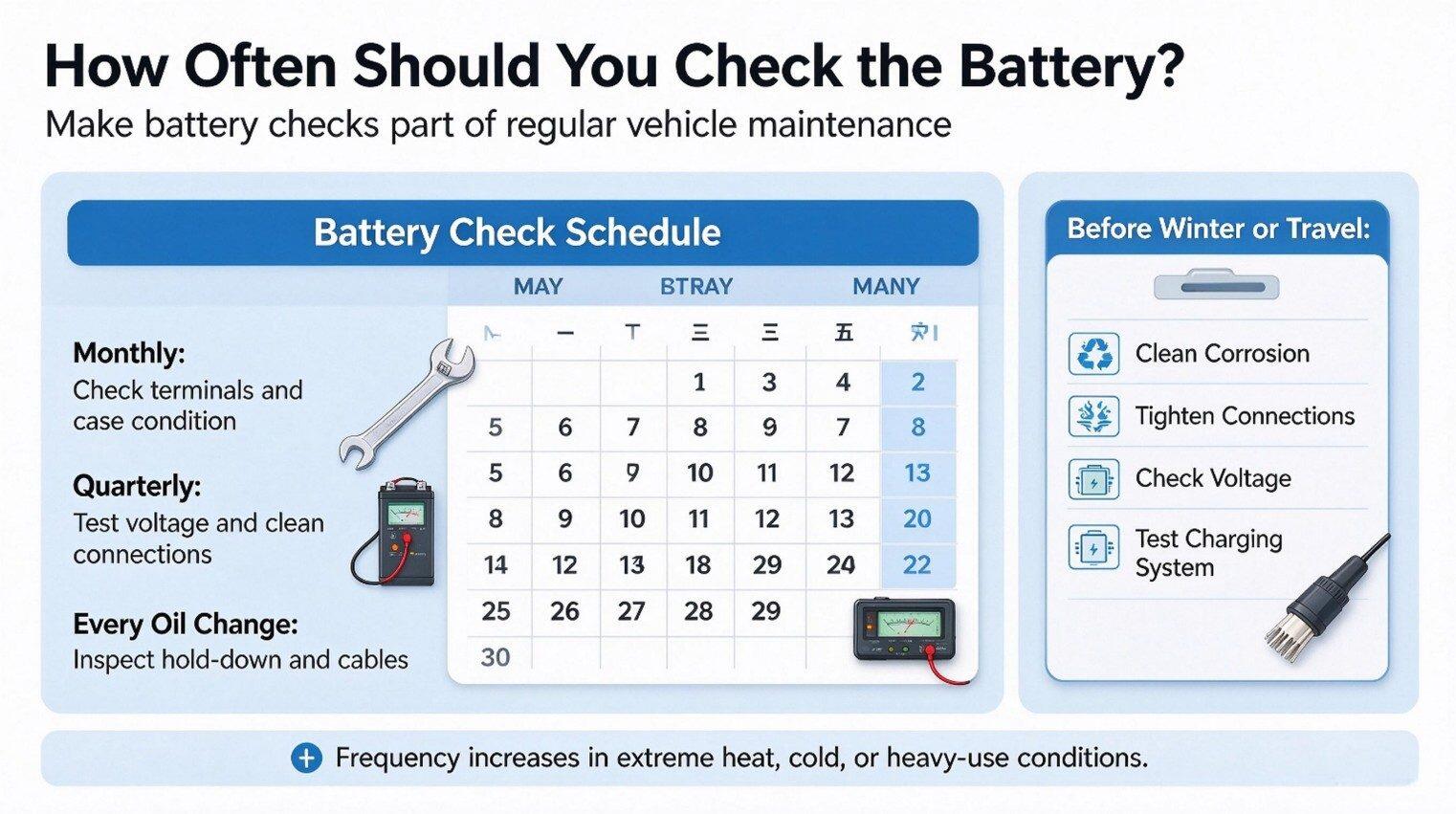
How often should I replace the battery in my car? Use this decision matrix
The fastest way to make the call is to combine age, climate, symptoms, and the latest test result.
|
Battery age and condition |
Climate or use |
Recommended action |
|
Under 3 years, no symptoms |
Normal mixed driving |
Inspect terminals and hold-down hardware during routine service; keep the purchase date recorded. |
|
Under 3 years, repeated discharge |
Any climate |
Diagnose charging voltage, parasitic draw, connections, and driving pattern; do not assume age rules out failure. |
|
3-5 years, no symptoms |
Mild or cool climate |
Test at least annually and before a major trip or severe-weather season. |
|
Around 3 years |
Very hot climate or frequent short trips |
Test now; heat and incomplete recharging raise risk earlier. |
|
Over 5 years, test passes |
Any climate |
Continued use may be reasonable, but plan replacement and retest before high-consequence travel. |
|
Any age, test fails after full charge |
Any climate |
Replace with the vehicle-specified type and rating. |
|
Any age, swelling, crack, leak, odor, or heat |
Any climate |
Stop handling it and arrange professional service. |
|
Any age, jump needed more than once |
Any climate |
Test the battery, alternator, starter, and parasitic draw before deciding. |
A jump starter belongs in the risk-control column, not the diagnosis column. Eigotrav's jump starter collection lists portable lithium packs for 12-volt vehicles. Check the vehicle voltage, fuel type, engine displacement, and the individual product page before choosing one.
How often do car batteries need to be replaced in hot and cold climates?
Heat usually shortens battery life; cold exposes the weakness that heat and age have already created. High temperature speeds internal degradation and water loss. Cold slows battery chemistry while the engine requires more effort to turn, so a marginal battery often reveals itself on the first freezing morning.
|
Condition |
Typical effect |
Testing and replacement approach |
|
Hot southern or desert climate |
AAA says approximately 3 years is typical in hot southern locations |
Begin annual testing no later than year 3, and consider testing earlier before summer travel. |
|
Cooler northern climate |
AAA says 5 years or longer may be possible |
Still begin annual testing at year 3; test before winter because cold raises starting demand. |
|
Frequent short trips |
The alternator may not restore all energy used for starting |
Combine trips when practical and investigate persistent low charge. |
|
Vehicle parked for weeks |
Natural self-discharge and small standby loads lower state of charge |
Follow the vehicle and battery maker's storage guidance; test before returning to service. |
|
Rough roads or loose hold-down |
Vibration can damage internal connections and plates |
Secure the correct hold-down and inspect the case. |
|
Coastal humidity or road salt |
Corrosion can raise connection resistance |
Inspect and clean terminals using the service procedure for the vehicle. |
In cold weather, a portable jump starter is most useful when it is charged, within its stated operating-temperature range, and sized for the engine. Do not leave any lithium device where cabin temperatures exceed its storage limits. The Eigotrav PD-JA2 is listed at 6000A peak for 12-volt vehicles up to 10L gas or 8.5L diesel and includes a 150PSI compressor. Those are manufacturer specifications, not a promise that it can start every engine in every condition.
How often should a car battery be replaced if voltage is low?
Low open-circuit voltage means low state of charge. It does not, by itself, prove that the battery has lost capacity. Interstate Batteries says a charged car battery should read 12.6 volts or higher, while 11.9 volts or below is considered dead in its general guidance. It also gives 13.7-14.7 volts as a typical engine-running range.
Use voltage as a screening tool:
|
Measurement condition |
General reading |
Meaning and next step |
|
Engine off, battery rested |
12.6V or higher |
Fully charged or near full charge; this does not prove adequate cranking capacity. |
|
Engine off, battery rested |
Below 12.6V |
Partially discharged; charge with equipment approved for the battery type, then retest health. |
|
Engine off, battery rested |
11.9V or lower |
Deeply discharged under the cited general guide; investigate why before declaring the battery failed. |
|
Engine running |
13.7-14.7V in the cited conventional range |
The charging system is active, but smart charging systems can vary; compare with vehicle specifications. |
Turn off loads and follow the meter manufacturer's safety instructions. A recently charged battery may show surface charge, and a recently used vehicle may not be at true rest. More important, a battery can show 12.6V and still collapse under starter load. A conductance or load test is the better health check.
A useful calculation is:
Remaining CCA percentage = measured CCA / rated CCA x 100%
If a tester measures 390 CCA on a battery rated at 600 CCA, the calculation is 390 / 600 x 100% = 65%. Do not treat 65% as a universal replacement law. Tester algorithms, temperature, state of charge, and vehicle requirements differ. Follow the tester result, the vehicle specification, and the technician's diagnosis.
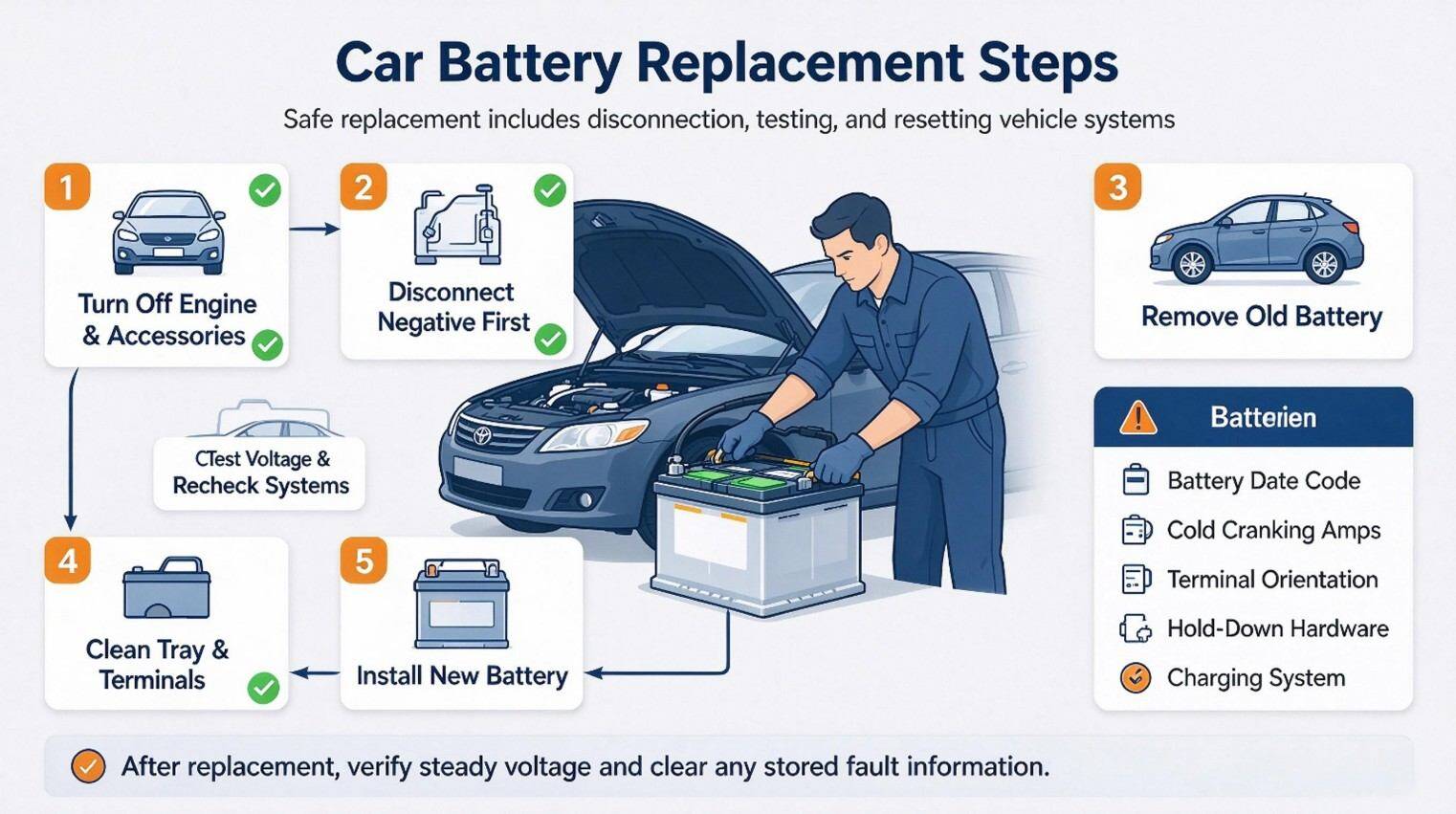
How often should you replace car battery if you drive short trips?
There is no separate calendar that applies to every short-trip car. Starting takes energy, and a five-minute drive may not put it all back. Heated seats, defrosters, lights, and fans make the balance worse. The battery can spend much of its life partially charged, which accelerates deterioration.
If most trips are short:
- Record the battery installation date.
- Inspect the terminals and hold-down during regular service.
- Start annual professional testing at three years, or sooner if cranking changes.
- Have repeated low charge diagnosed instead of using one jump after another.
- Follow the vehicle maker's storage and charging guidance. Modern energy-management systems may require specific procedures.
A jump starter is sensible backup for a short-trip vehicle, but repeated use is evidence, not a maintenance routine. If the same battery needs two jumps, find the cause.
How often should you replace your car battery before a road trip?
Do not replace a healthy young battery solely because a trip is long. Test first when the battery is three years old or older, when starting has changed, or when the route includes remote roads, extreme heat, or freezing weather. Check that the terminals are tight, the case is secure, and the charging system has no warning signs.
Pack the correct emergency equipment before departure. For a straightforward jump-start backup without an integrated compressor, the Eigotrav PD-J220 is listed as a 6000A-peak 12-volt pack for up to 10L gas or 8.5L diesel engines. Drivers who want a higher listed peak output and an integrated inflator can compare the PD-F130, which the product body lists at 9000A peak, all gas engines, and up to 12.0L diesel. Confirm compatibility and current specifications on the product page before purchase.
Charge the pack before leaving, store it as its manual directs, and check it periodically. A flat emergency pack in the trunk is only extra weight.
How often to change battery in car with start-stop
Use the battery type specified for the vehicle. A basic start-stop system may use EFB, while systems with greater cycling demand or regenerative braking often use AGM. The charging strategy may be calibrated to that chemistry, and some vehicles require the replacement battery to be registered or coded in the battery-management system.
Replacing an AGM with a conventional flooded battery can lead to poor operation and premature failure even if the case fits. Replacing EFB also requires an approved like-for-like unit or an upgrade specifically allowed by the vehicle maker. Check the owner's manual, application catalog, and service information rather than choosing only by price or CCA.
How often replace car battery after jump starts?
One jump-start does not automatically mean replacement. A light left on overnight can flatten a healthy battery. Charge it correctly, then test the battery and charging system.
Repeated jumps change the answer. If the car needs another jump after normal driving or after a proper recharge, arrange diagnosis. The causes can include reduced battery capacity, an alternator problem, a parasitic draw, corroded connections, or a starter fault. Continuing to jump without diagnosis can leave you stranded and may expose damaged equipment to further stress.
Follow the vehicle and jump-starter manuals. A common safe sequence is to switch off the ignition and accessories, connect the positive clamp to the positive terminal, connect the negative clamp to the approved ground point, confirm polarity, and then operate the pack as instructed. After the engine starts, remove the negative clamp first and the positive clamp second. Never use an override mode unless the specific device manual confirms the feature and explains its risks.
How often should I change car battery if tests pass?
A passing test means the battery met the tester's criteria at that moment. It does not reset its age. A three-year-old battery in a mild climate may have substantial service left, while a five-year-old battery that passes deserves closer planning because deterioration can accelerate.
Keep using it if the test is strong, there are no symptoms, the case is sound, and the consequence of an unexpected failure is manageable. Retest before severe weather or a remote trip. Consider preventive replacement when the battery is beyond its normal range and failure would create a safety or access problem, even if the latest result is marginally acceptable.
How to choose the correct replacement
Match all of the following:
- Battery chemistry: flooded, EFB, AGM, or the exact type specified by the vehicle maker.
- Group size and dimensions: the battery must fit the tray and hold-down.
- Terminal position: cables must reach without strain or reversed routing.
- CCA or Ah: meet, but never go below, the vehicle manufacturer's minimum.
- Venting: batteries mounted inside the passenger compartment or trunk may require a vent connection.
- Battery-management procedure: some vehicles require registration, coding, or memory support during replacement.
A higher CCA number is not automatically better. Fit, charging compatibility, reserve needs, climate, and fresh stock matter. If the vehicle has complex electronics or the battery is difficult to reach, professional installation may be the safer choice.
Frequently Asked Questions
How often should I change my car battery?
Plan around three to five years for a conventional 12-volt starter battery, then decide from testing, climate, and symptoms. Start annual testing at year three rather than replacing automatically on the anniversary.
How often should I replace my car battery if it still starts normally?
Normal starting is encouraging but not conclusive. Once the battery is three years old, test it annually; before a high-consequence trip, test it again if it is near or beyond the usual service range.
How often should you change your car battery in a hot climate?
AAA says approximately three years is typical in hot southern locations. Treat year three as a testing and planning point, not an automatic deadline, and act sooner on a weak result or physical damage.
How often do you change car battery in a cold climate?
Cooler climates may allow five years or longer, according to AAA, but cold raises cranking demand. Test annually from year three and before winter, especially if the engine has begun to crank slowly.
Can a battery be bad even if it reads 12.6 volts?
Yes. Resting voltage mainly indicates state of charge. A battery can show 12.6V yet lack sufficient current under load, so use a load or conductance test when health is in doubt.
Should I replace the battery after one jump-start?
Not necessarily. Correct the reason for discharge, fully recharge using an approved method, and test. Replace the battery if it fails testing, has damage, or repeatedly loses charge after the rest of the system has been checked.
Keep a no-start from becoming a roadside emergency
Record the battery date today. If it is three years old, book a test before the next heat wave, freeze, or long trip. Replace it when testing and condition justify the decision, and return the old lead-acid battery through an approved collection channel.
For backup between now and replacement day, compare Eigotrav's portable jump starters by vehicle voltage, gas or diesel engine size, peak output, and whether you need an integrated air compressor. Keep the selected pack charged and follow both manuals every time.
Subscribe To Our Newsletter
You Can Get The News Of Our Products
SIGN UP
To be the most trusted mobile energy companion worldwide — making every drive, every trip, and every adventure worry‑free.
📮support@eigotrav.net
Payment Methods